The moving book
A Pioneering Approach to the Interactive 3D Digitization of Historical Toy Picture Books
Moving books – books with characteristic pull-tabs, rotating wheels, and other mechanical elements/interactions beyond simply opening and turning their pages – are by no means a marginal exception to the standard codex. Rather, this genre has been familiar since the age of Gutenberg, ranging from volvelles, books of sins, and early modern anatomical textbooks to modern pop-up comics, artist’s books, and, above all, toy picture books. The latter are by far the most diverse and internationally widespread form of moving books, with their first day in the late nineteenth century in the spectacular works – remarkable even by today’s standards – of the ingenious Munich-based paper engineer Lothar Meggendorfer.
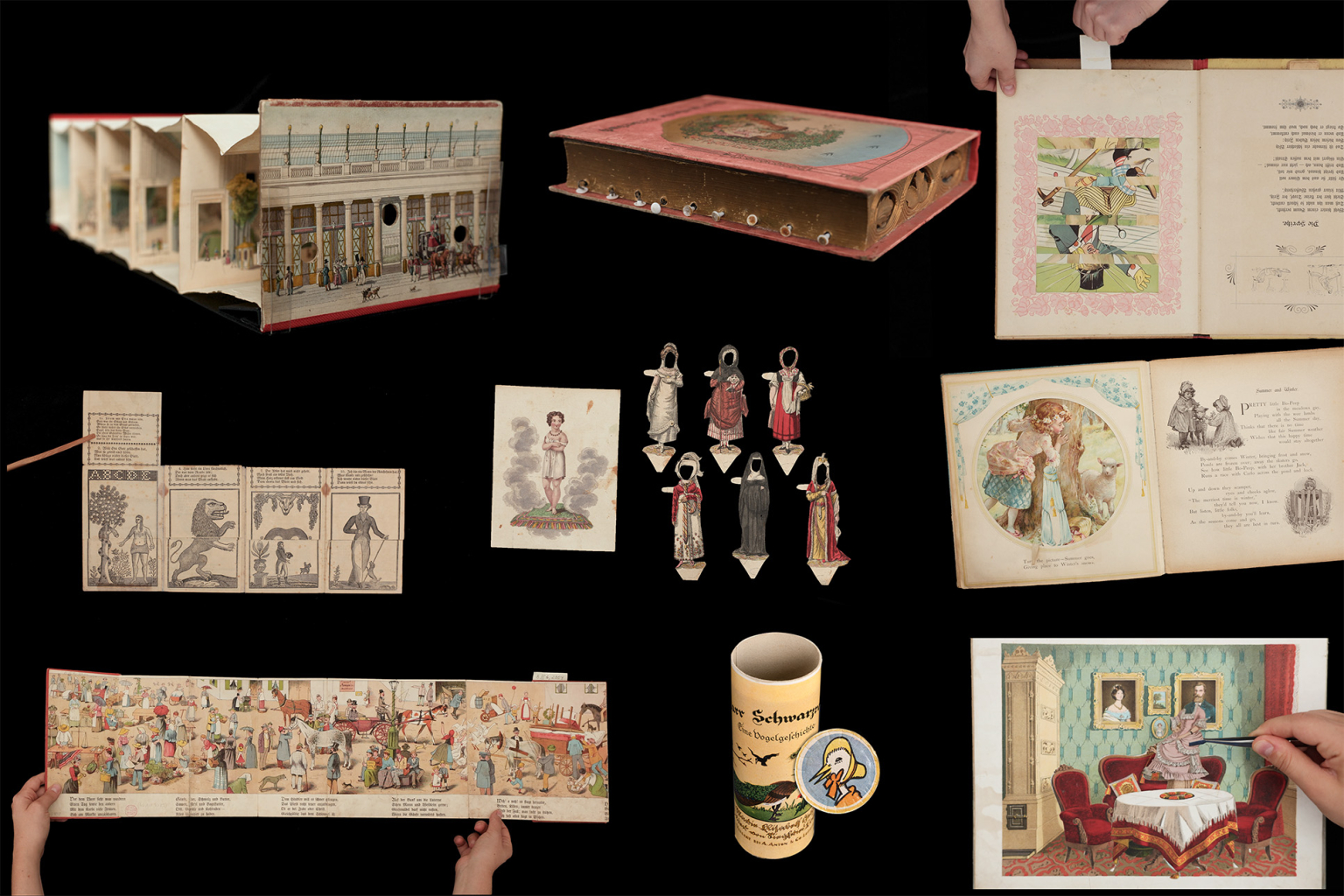
As the central research library of the German Empire and a member of the Arbeitsgemeinschaft Sammlung deutscher Drucke, founded in 1989 – the virtual retrospective national library for the period before 1913 – the Staatsbibliothek zu Berlin (SBB) holds an outstanding collection of historical toy picture books, both in terms of quality and quantity. As this collection was systematically built up, it documents the full typological range of this multifaceted genre. This range encompasses numerous intermediate forms, from works that open up a broad interactive and performative space – for example, paper theatres and toy picture books with movable figures – to the various forms of pop-up, transformation, and rotating picture books, whose possibilities for movement are more predetermined.
With the aim of making a representative selection of these works virtually accessible to researchers, while at the same time testing a model workflow for the digital replication of other kinetic collection objects in cultural heritage institutions – such as altarpieces, astrolabes, and automata – the SBB was pleased to secure project funding from the German Research Foundation (DFG). The specific aim of its project, Pop-up 3D – Digitization and Interactive Visualization of Historical Toy Picture Books in Research-Led Practice, is to transform a corpus of 100 public-domain examples of these works, which occupy a space between books and toys, into an Open Access resource in such a way that arbitrary sequences of movement can be cited and thus reproduced by third parties. Researchers from various disciplines have consistently regarded both non-referenceable forms of presenting historical toy picture books and non-interactive forms of presentation as inadequate.
The project therefore represents a genuine pioneering undertaking with considerable potential for the future. To date, the 3D digitization activities of archives, libraries, and museums have largely remained focused on static artefacts such as sculptures, coins, and seals – notwithstanding a recent EU call for the digital replication and analysis of dynamic cultural heritage objects.
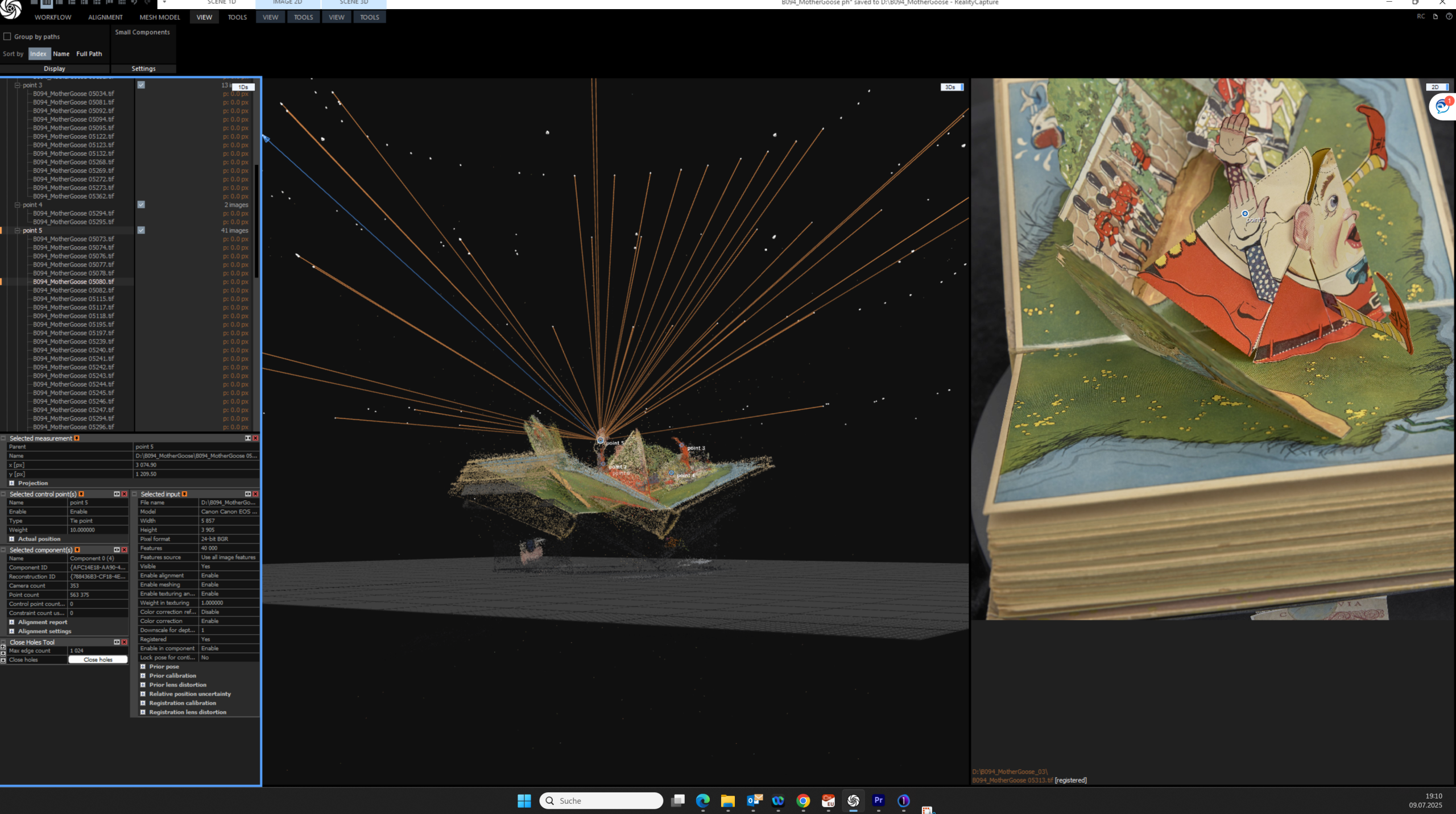
The interactive 3D visualizations will be created using photogrammetry and, in particular, animation technologies commonly used in game design. Beyond the technical considerations, this choice is also appropriate from a media-historical perspective, as toy picture books and computer games are closely related in terms of their media genealogy. The reconstruction of these lines of development was, incidentally, the subject of an accompanying research and exhibition project undertaken by the SBB, funded by the Federal Government Commissioner for Culture and Media and supported by the Computerspielemuseum Berlin.
The presentation scenario envisioned in the context of Pop-up 3D, however, centers on the static, “flat” view of the selected toy picture books in the SBB’s collection portal, stripped of all movement functions. This view will be linked, via external platforms such as the AV Portal of the German National Library of Science and Technology (TIB), both to video recordings of exemplary sequences of movement from the respective work, which can be cited with frame-level precision, and to its interactive visualization.
The planned additive approach, which combines 2D digitization, video recordings, and interactive 3D visualization in a synoptic, multimodal presentation, is intended to provide a precise impression of the materiality, content, and mechanics of each toy picture book. It is based on the recommendations of a 2018 concept study by the SBB on the digital replication of dynamic book objects as part of the Federal Ministry of Education and Research’s eHeritage program. The validity and scholarly appropriateness of this approach were recently reassessed through dialogue with researchers from a range of disciplines, including book and art studies as well as comparative literature. This dialogue format was organized by the SBB in cooperation with the German National Library – the German Book and Writing Museum at its Leipzig site also holds an extensive collection of nineteenth- and, in particular, twentieth-century toy picture books – and the NFDI4Culture consortium, which subsequently intended to develop the initiative into a dedicated workshop series involving researchers from additional disciplines.
Within the context of the Pop-up 3D project, however, cooperation with NFDI4Culture extends beyond the organization of joint events. The collaboration with the NFDI consortium has also proved highly valuable for the practical implementation of the project, particularly with regard to the further development of the open-source 3D viewer Kompakkt into Semantic Kompakkt as part of the 4Culture work area “Digitization and Enrichment of Digital Cultural Assets” jointly coordinated by TIB and SBB. The aim of these collaborative activities is to equip Kompakkt with annotation tools that allow arbitrary interactions with 3D models to be documented and made reproducible for third parties – in other words, a model of collaborative potential worthy of a toy picture book itself.
Projectnumber: 527302005
Author: Christian Mathieu