Pop-up 3D in DD
Our Digital Pioneering Project Comes to Dresden
Right on time for this year’s World Children’s Day, a new exhibition opened in Dresden: spread across several sections, from Hans Huckebein to Conni: Children’s and Young Adult Literature Through the Ages traces the development and diversity of book production for young audiences in Germany over the past 150 years. Beyond its scholarly content, the exhibition – accompanied by a podcast and a varied programme of events – aims to bring greater attention to a largely overlooked special collection of the Saxon State and University Library Dresden and to place it more firmly on the agenda of children’s literature research.
The Dresden exhibition shares with our German Research Foundation (DFG)-funded pioneering project Pop-up 3D the aim of providing researchers with a useful service. The project focuses on the scholarly appropriate interactive digitization of movable collection objects, using historical pop-up books as its example. In digitally replicating the selected reference corpus from the late nineteenth and early twentieth centuries, the project is primarily concerned with making the characteristic interactive features of these works – situated somewhere between books and toys and enabled by rotating discs, pull-tabs, and other paper mechanisms – citable and thus reproducible by third parties. Naturally, this involves the use of animation technology, such as that commonly used in game design. After all, pop-up books are the computer games of the analogue age – with a comparably large popular following!
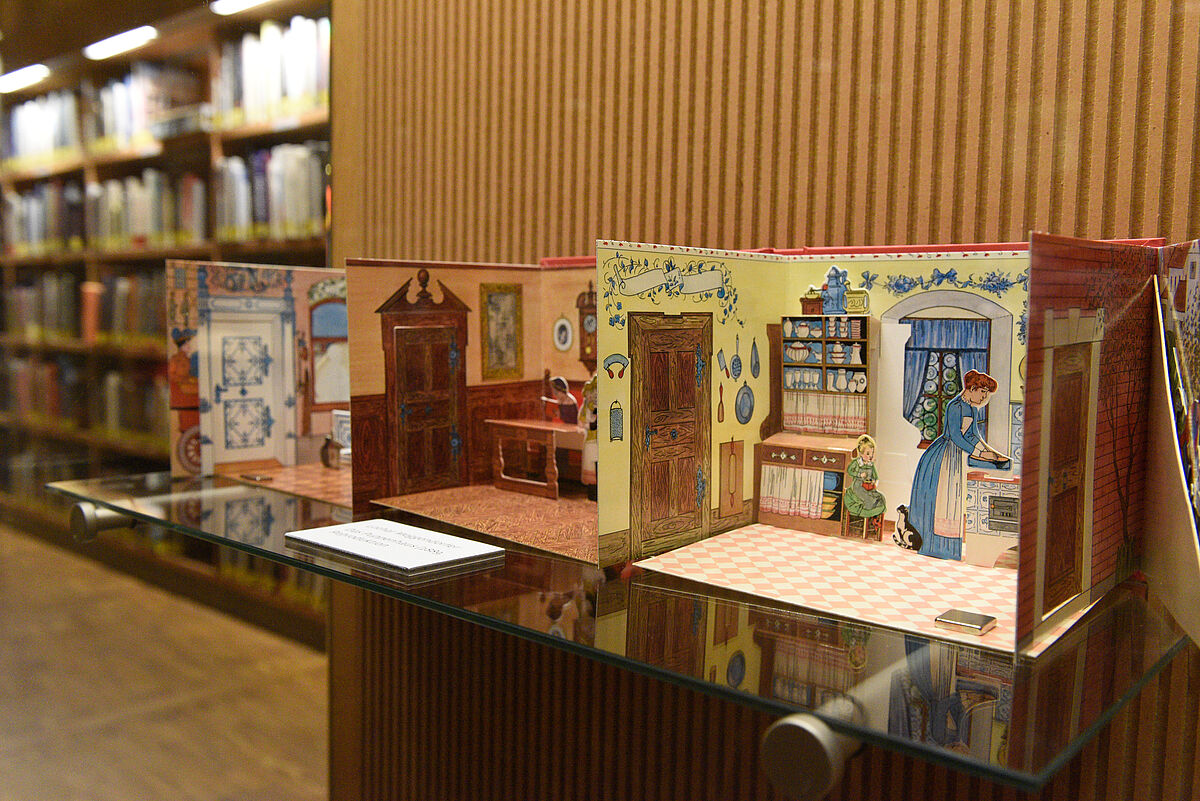
Lothar Meggendorfer: ‚Das Puppenhaus‘. Foto: SLUB Dresden/ Stephan Zwerenz
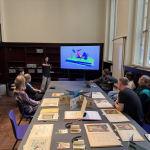
In particular, the pop-up books of the highly inventive Munich artist and paper engineer Lothar Meggendorfer, which are astonishing even by today’s standards, were sold all over the world – including Das Puppenhaus: eine Festgabe für brave Kinder, published in 1889. This leporello-style pop-up book not only invites play, but even makes a guest appearance: At a media station in the Dresden exhibition, we are using a small online presentation to demonstrate, among other things through this example, how this interactive book genre can be transferred into a digital representation.
Author: Christian Mathieu