
Symmetry of Objects in Photogrammetry
The symmetry of movable elements, like the „donkey,“ presented a challenge during the digitization of the 1932 pop-up book „The Pop-up Pinocchio.“ These elements, when the page was opened, were almost identical on both sides, which made it difficult for photogrammetry software to correctly assign the photos to the appropriate positions in the 3D model. Lack of unique features : Photogrammetry relies on detecting and matching characteristic points (key points) between images. When an object is nearly identical on both sides, algorithms struggle to assign these points, they may incorrectly match features from the left and right sides.This can sometimes cause two overlapping 3D reconstructions, even without any camera movement.
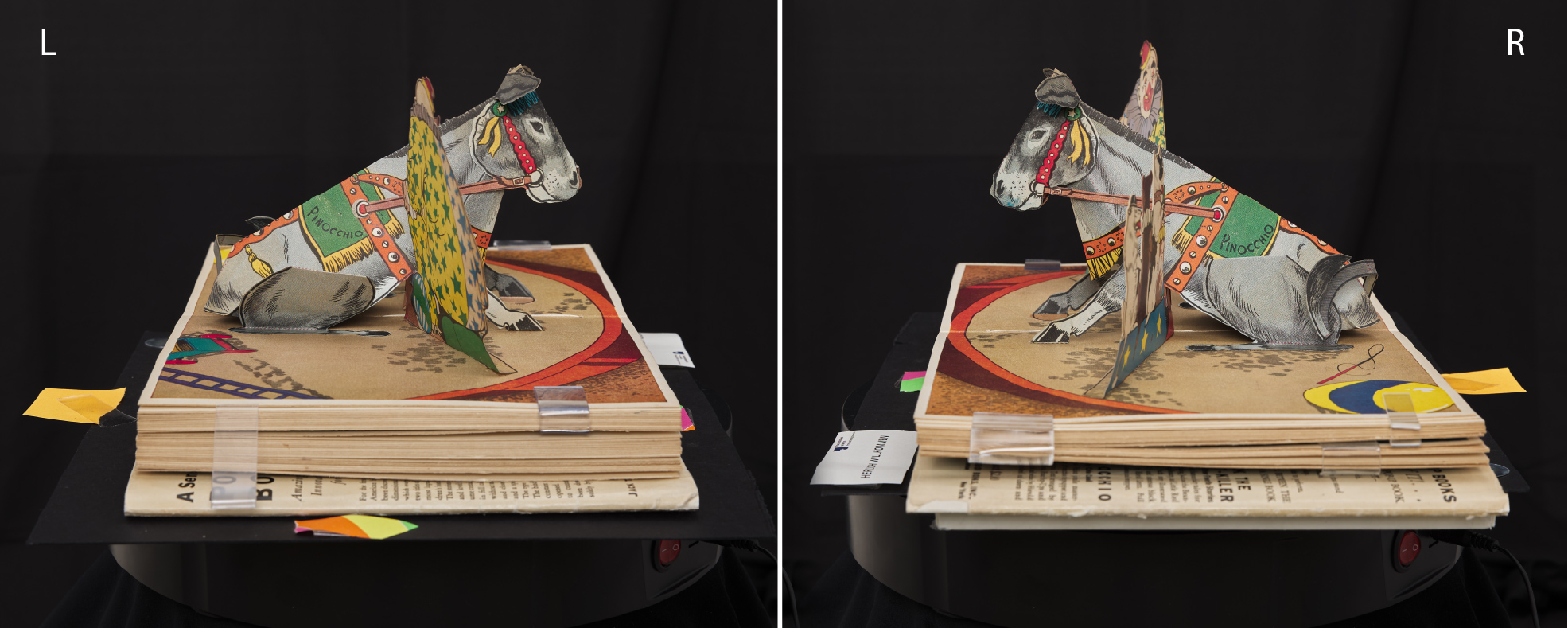
Colorful paper elements as control points
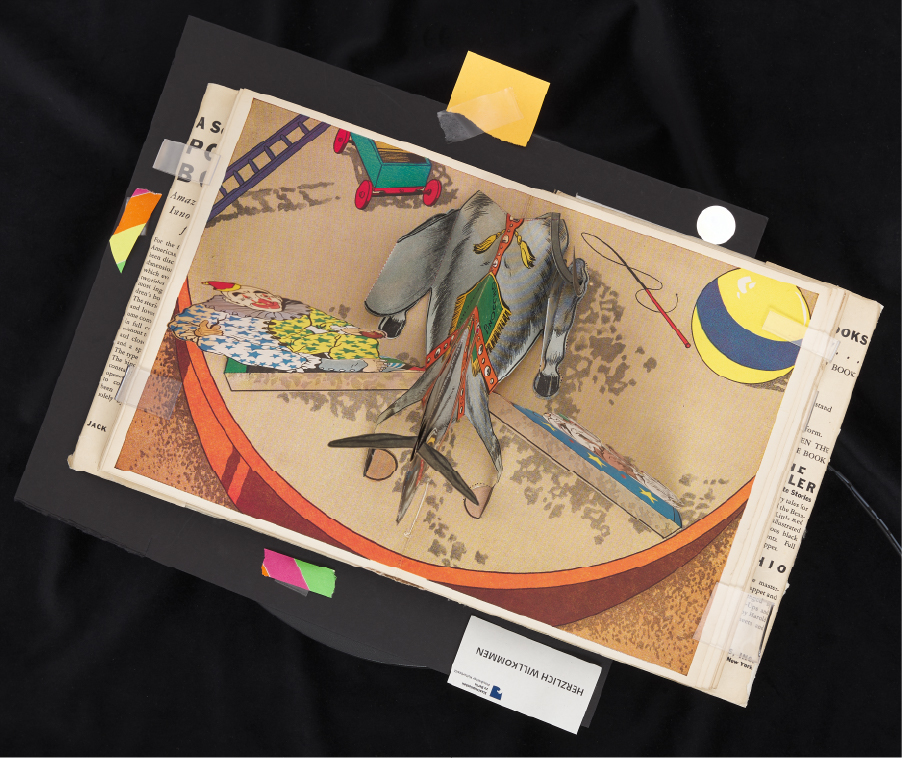
Thin and delicate paper components provide very little texture and limited parallax at certain angles, which makes triangulation and thickness reconstruction difficult. As a result, holes or blurred edges often appear in the model. Attaching colored papers of contrasting shapes to the rotating platform introduced distinct, non-repetitive features visible in all photographs. This allowed the algorithm to more easily align the images to these stable reference points instead of confusing the object’s mirrored sides. Fixed markers on the rotating turntable served as coordinate references, improving scene orientation and stabilizing the reconstruction.
Information about the photo: Canon EOS R6m2, F\10, 1.6 Sek. ISO-100, 52 mm
Author: Natalia Sucharek